
From Idea to App Store
Designing a Smarter Investment Journal
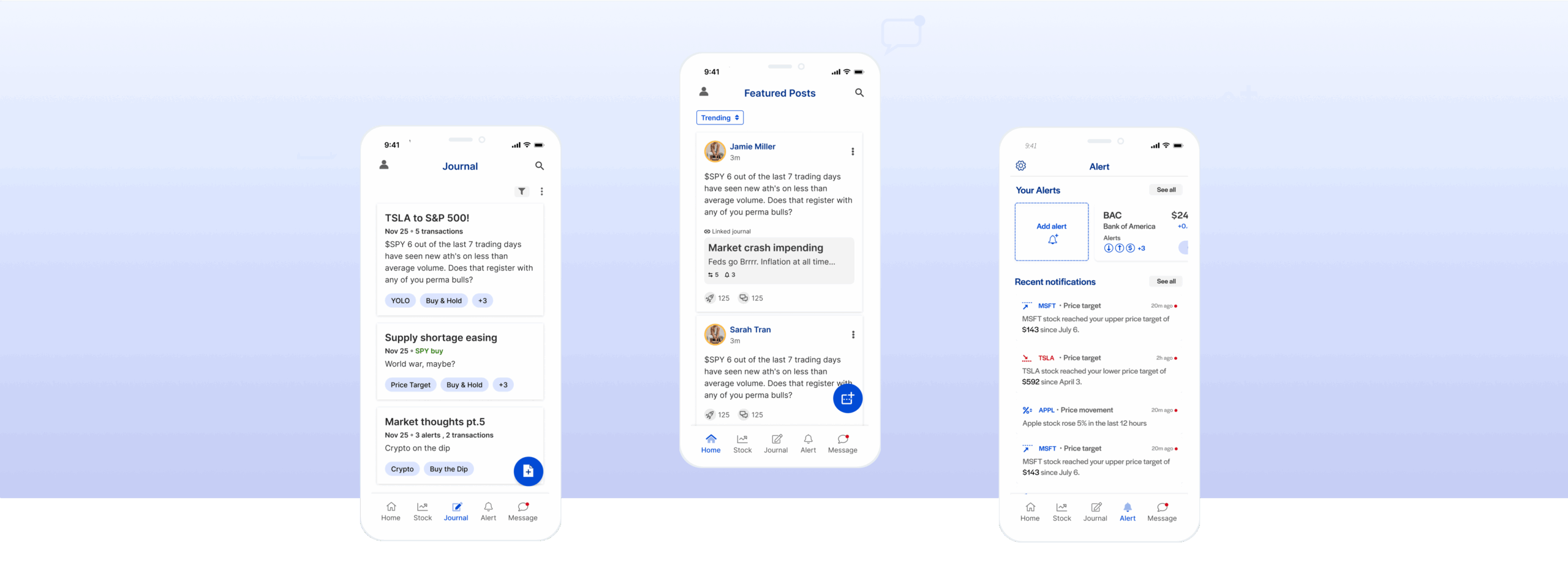
Overview
Most stock trading apps help users trade. None of them helped users learn from their trades. Stockwise was built to fill that gap — a financial web app that lets investors document their decisions, track what influenced them, and build better investing habits over time. I co-founded the company and led design end to end, from the first sketch to launch on the App Store.
Outcomes
2021
Launched on the Apple App Store
2
Core features shipped
What I did
- Led end-to-end design including user research, wireframing, visual design, and user testing
- Drove the MVP feature definition with three co-founders
- Built a design system from scratch to streamline the team's workflow
- Conducted usability testing with five participants on the wireframe
- Mentored one junior designer throughout the process

Challenges
Retail investors, especially newer ones, often make emotional decisions without a clear record of their reasoning. When a trade goes wrong months later, they have no way to understand why they made the call in the first place. Existing apps like Robinhood, Commonstock, and Stock Alarm all focused on executing trades — none gave users a way to document their thinking.
Core question
How do we help investors reflect on their decisions so they can actually get better over time?
Research
I conducted a competitive audit across four of the most widely used trading apps: MyWallSt, Commonstock, Stock Alarm, and Robinhood. The pattern was consistent — all of them optimized for trading speed, but none offered any form of user-added documentation or note-taking.
One additional insight stood out: the average Robinhood user is 31 years old, and younger generations are entering the market faster than ever. These users are mobile-native and comfortable with technology, but they are learning to invest largely on their own, without guidance or structure.
That gap was our opportunity.

Ana is a 25-year-old software engineer who started investing in late 2020. She is engaged and careful, but when trades go wrong, she struggles to understand why — because she never documented her original reasoning. She wants a tool that captures not just what she bought, but why: what news influenced her, what the market sentiment was, and what she was thinking at the time.
Wireframe and User Testing
I built wireframes around one core user story: as an investor, I can create a journal entry to document my trade and the reasoning behind it. After building out the wireframe and a basic prototype, we ran usability testing with five participants.


The testing revealed a hard lesson — we had made assumptions about user needs that turned out to be wrong, leading to a significant redesign of several features


User Feedback
Design system
To support a small team moving fast, I built a design system from the ground up covering color, typography, components, and templates. This gave the junior designer a clear foundation to work from and kept the visual language consistent as the product grew


Reflection
We brought users into the process too late. By the time we ran our first usability tests, we had already built a full wireframe and a visual prototype. The issues we uncovered could have been caught much earlier with a simple paper prototype or a round of user interviews before any wireframing began.
The lesson was straightforward but costly: validate early and often. Testing a rough sketch takes an afternoon. Redesigning a feature after visual design is done takes weeks. Getting in front of real users before committing to a direction would have saved significant time and kept the team aligned throughout.